
Okenite
Okenite is a calcium hydrate silicate, commonly reported formula Ca10Si18O46·18H2O, belonging to leafy silicates. The historical formula of the board is a simplified representation and it is distinct from the most recent structural formulas.
From specimen to structure

Fibres or acicular aggregates
Teaching reconstruction of the dress. Colours and surfaces illustrate the appearance of the mineral. Indicative dimensions.
Reference photograph · Green slash · CC BY-SA 3.0
Crystal unit cell
Coordinates of COD 9015622 diffraction. The spheres locate atomic sites and auctions highlight the vicinity in the cell.
In the COD sample the cell edges are a = 9,690 Å, b = 7,280 Å e c = 22,020 Å. The angles α, β and γ are 92,70°, 100,10° and 110,90° respectively.
Composition reported in the sample record Ca5 H18 O32 Si9. Download the CIF · COD 9015622 · CC0
Elements and site occupancies in the unit cell
- Ca 10,00
- O 64,00
- Yes 18,00
The totals are the sums of the site occupancies given in the CIF file.
Key data
- Class
- Silicates
- Reference formula
- Ca10Yes18O46·18H2O
- Mohs hardness
- 4,5–5
- Observed form in the model
- Fibres or acicular aggregates
- COD sample space group
- P -1
- Sites represented by cell
- 102
Specimen photographs
Look at the shapes, aggregates and colours of specimens from different collections.
Green slash · CC BY-SA 3.0 · WebP derivative
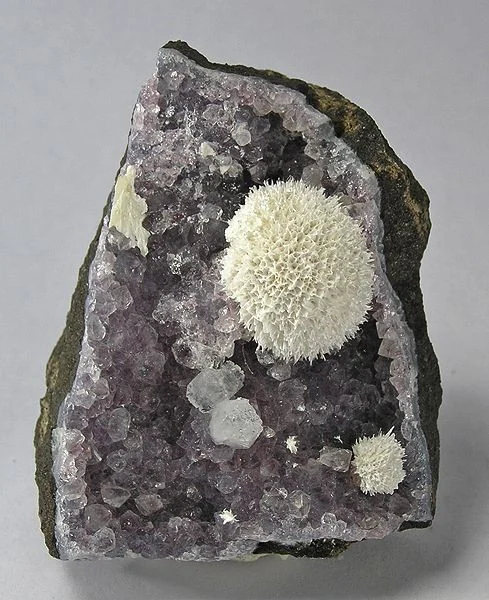
Robert M. Lavinsky · CC BY-SA 3.0 · WebP derivative

GorissM · CC BY-SA 2.0 · WebP derivative
Study the mineral
How to identify it
It often forms white tufts of very thin and flexible crystals, with a cotonous look, in basaltic cavities. It is very delicate and should not be touched or brushed: the fibres break easily and damage the specimen.
How it forms
It is formed in the cavities of basaltic rocks, often with apophyllitis, gyrolite and other hydraulic silicates. The fibrous aspect is a fragile crystalline aggregate and should not be confused with regulated asbestiform minerals without appropriate identification.
Uses and applications
Okenite is a collector’s sample and not an industrial raw material; fragility affects exposure and handling. Storage must avoid shocks, vibrations and direct contact.
Laboratory question
It is useful to observe radiated aggregates, hydrated silicates and mineralization of volcanic cavities. The sample is studied without manipulation, using magnification or images to document its weaving.
Compare other minerals in the catalogue
Sources and further reading
See also the historical museum card
 - Ca5[Sighs]9O23].9(H2O) -


MINERALOGICAL CLASS: Silicate
GROUP: Trimetric
SYSTEM: Triclino
SPACE GROUP: P1
EDGEMENT: {010}
ABITO: Acicular (fibrous, capillary) radial, often has crystallizations called cotton flakes; sometimes it is turned into mass.
DUREZZA: 4,5 - 5
SPECIFIC PESO: 2,33
REFRATION INDEX: α=(1.512-1.532) β=(1.514-1.535) γ=(1.515-1.542) δ=(0.003-0.010)
COLOURS: Colorful, white, yellowish, bluish
LIGHT: Vitreus, Perlaceus
TRANSPARENCE: Transparent, translucent
SFALDATURE: (001) good
STRISCIO: White
FRAME: Sub-concoid
PLEOCROISMO: - Yes.
GENESI: It originates in cavities of basaltic rocks and in some eruptive lava ("pillow" lava, underwater laves typical of the seabeds of the ocean chains).
JACIMENTS: India (Poona area) is the most important findings, Okenite is also located in the USA, Chile, Greenland. Small crystals are found in the lava flows of Etna, Sicily.
HISTORY CENTRE: It was discovered by Kobell in 1828 in a sample taken from Ile Disko (Groenlandia); Kobell then decided to dedicate this mineral to the German naturalist Lorenz Ockenfuss, (1779-1851).
OTHER CHARACTERISTICS AND USE: Sometimes Okenite, with its particular radial fibrous increases, characterizes entire cavities of basaltic rocks that are called geodes d'Okenite.
COMMENT: The Okenite is very characteristic for its shape but the small aghetti that compose it are also very fragile.
EXPENDITURE CHAMPIONS TO MUSEUM:
STANCE:
TECA:
DESCRIPTION CAMPIONE: