
Molybdenite
Molybdenitis is molybdenum sulphide, MoS2, with layers structure and perfect basal nuance. The weak cohesion between the layers explains the untuious feeling and the dark grey sign left by the mineral.
From specimen to structure
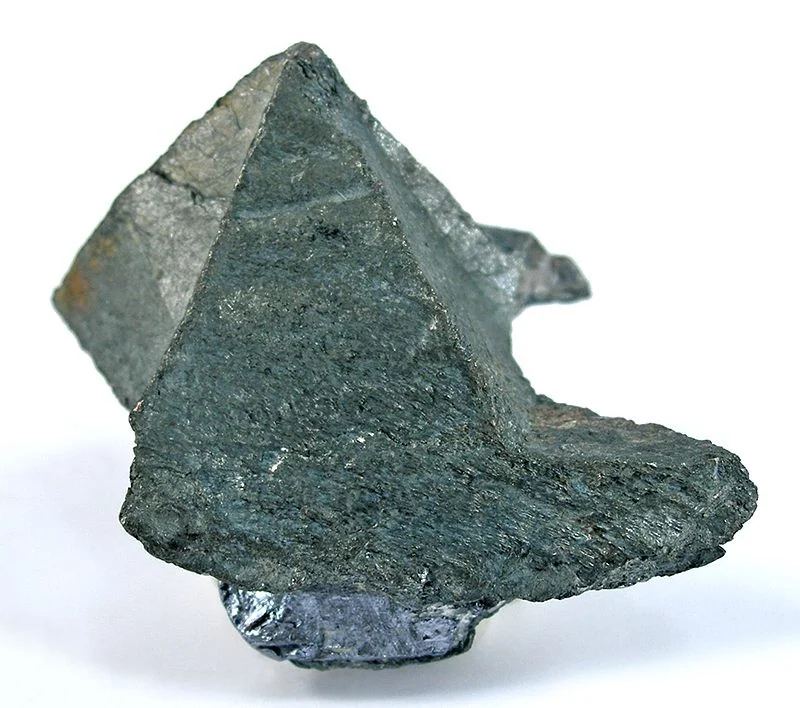
Lamellar crystals
Teaching reconstruction of the dress. Colours and surfaces illustrate the appearance of the mineral. Indicative dimensions.
Reference photograph · Robert M. Lavinsky · CC BY-SA 3.0
Crystal unit cell
Coordinates of COD 9007660 diffraction. The spheres locate atomic sites and auctions highlight the vicinity in the cell.
In the COD sample the cell edges are a = 3,161 Å, b = 3,161 Å e c = 12,295 is the α, β and γ angles are 90,00°, 90,00° and 120,00° respectively.
Composition reported in the sample record Mo S2. Download the CIF · COD 9007660 · CC0
Elements and site occupancies in the unit cell
- Mo 2,00
- S 4,00
The totals are the sums of the site occupancies given in the CIF file.
Key data
- Class
- Sulphides and sulphosalts
- Reference formula
- MoS2
- Mohs hardness
- 1–1,5
- Observed form in the model
- Lamellar crystals
- COD sample space group
- P 63/m m c
- Sites represented by cell
- 6
Specimen photographs
Look at the shapes, aggregates and colours of specimens from different collections.
Robert M. Lavinsky · CC BY-SA 3.0 · WebP derivative

Black Tusk · CC BY 3.0 · WebP derivative

Jan Helebrant · CC BY-SA 2.0 · WebP derivative
Study the mineral
How to identify it
It is presented in lead or bluish grey lamella, glossy and very soft; it can be exchanged for graphite. Density, trace and chemical analysis help to distinguish it, while the only aspect is unreliable.
How it forms
It is common in porphyry and hydrothermal veins, often with quartz, wolf Through and limestone. Lamellar growth reflects the laminated structure of the lattice.
Uses and applications
Molybdenitis is the main source of molybdenum, used in resistant alloys and solid lubricants. The uses depend on the separation of the mineral and the refining of the metal.
Laboratory question
Molybdenitis illustrates the link between layers, shearing and lubricating properties; it is comparable with graphite, although having different composition. Non-destructive analysis and testing prevents damage to the slats.
Compare other minerals in the catalogue
Sources and further reading
See also the historical museum card
 - MoS2 -


MINERALOGICAL CLASS: Solfuro
GROUP: Dimetric
SYSTEM: Hexagonal
SPACE GROUP: P63/mmc
EDGEMENT:
ABITO: Diapersal hexagonal crystals. It has a layered structure formed by trigonal prisms. It rarely occurs in small crystals; more often in scales and lamellar aggregates
DUREZZA: 1 - 1,5
SPECIFIC PESO: 5
REFRATION INDEX:
COLOURS: Grey, grey-blue, lead grey, black.
LIGHT: Metallic
TRANSPARENCE: Opaque
SFALDATURE: {0001} Perfect
STRISCIO: Grey-blue, grey-green
FRAME: Shots, like Grafite.
PLEOCROISMO: Very strong.
GENESI: It is found in pegmatitis, in granite rocks and in iron and sulphides (Porphyry type).
JACIMENTS: It has a wide world wide spread; the main deposits are in Colorado (Climax), Canada (Ontario), England (Cornish), Sweden, Norway and Lapland.
HISTORY CENTRE: The name was given in 1807 and comes from Greek ♪= Lead, molybdenitis and graphite at first. The importance of this mineral has followed over the years that of the molybdenum element on the industrial market
OTHER CHARACTERISTICS AND USE: In the steel, electronics and chemistry industry. It is an exceptional dry lubricant, active even at extremely low temperatures, in the form of impalpable powder. It has the characteristic of forming submicroscopic thick pulverlant deposits that preserve intact the lube power. It is also used as a fat lube additive to achieve high performance at low temperatures.
COMMENT: The metallic shine makes it a good collector's mineral.
EXPENDITURE CHAMPIONS TO MUSEUM:
STANCE:
TECA:
DESCRIPTION CAMPIONE: