
Magnetite
The magnetite is iron oxide with Fe3O4 formula and cubic structure with reverse spinal cord. It is a ferrimagnetic mineral and can contain titanium or other elements in variable proportions.
From specimen to structure

Ottaedron
Teaching reconstruction of the dress. Colours and surfaces illustrate the appearance of the mineral. Indicative dimensions.
Reference photograph · James St. John · CC BY 2.0
Crystal unit cell
Coordinates of COD 9013529 diffraction. The spheres locate atomic sites and auctions highlight the vicinity in the cell.
In the COD sample the cell edges are a = 8,397 Å, b = 8,397 Å e c = 8,397 is the α, β and γ angles are 90,00°, 90,00° and 90,00° respectively.
Composition reported in the sample record Feather. Download the CIF · COD 9013529 · CC0
Elements and site occupancies in the unit cell
- Fe 24,00
- O 32,00
The totals are the sums of the site occupancies given in the CIF file.
Key data
- Class
- Oxids and hydroxides
- Reference formula
- Fe2+Fe3+2O4
- Mohs hardness
- 5,5–6,5
- Observed form in the model
- Ottaedron
- COD sample space group
- F d -3 m :2
- Sites represented by cell
- 56
Specimen photographs
Look at the shapes, aggregates and colours of specimens from different collections.
James St. John · CC BY 2.0 · WebP derivative
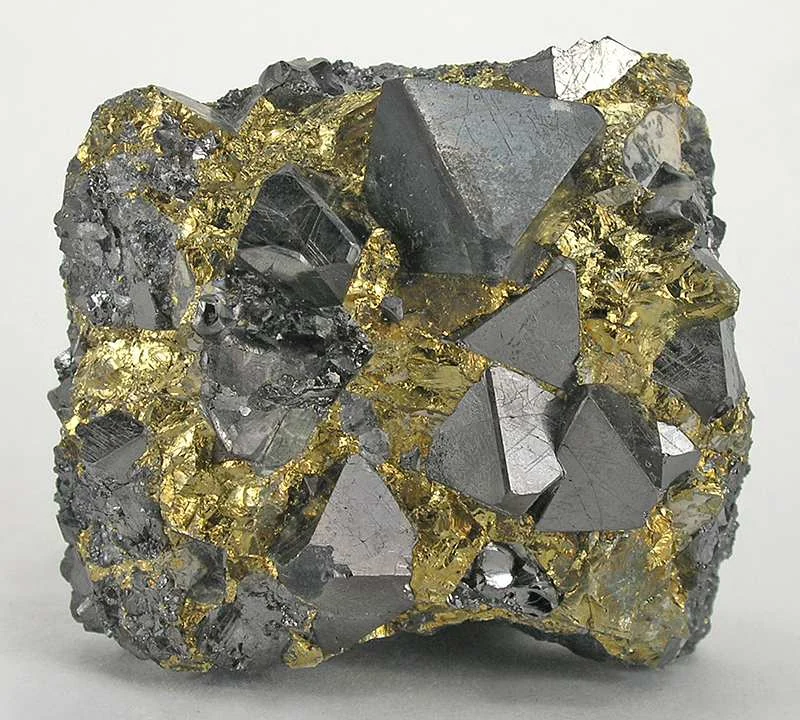
Robert M. Lavinsky · CC BY-SA 3.0 · WebP derivative

Hannes Grobe · CC BY-SA 4.0 · WebP derivative
Study the mineral
How to identify it
It is black, with metallic or submetallic gloss and black track; it often attracts a magnet, but the intensity depends on size and composition. The magnetic response is distinct from that of metal materials or mixed samples.
How it forms
It forms in magmatic and metamorphic rocks, iron deposits and alteration products; it can also stem from biological processes. The relationship with hematitis shows two ferrifer oxides with different magnetic structures and properties.
Uses and applications
Magnetite is an important iron mineral and is also used as a dense medium in some separation processes. The quality of the mineral and the content of impurities determine the convenience of extraction.
Laboratory question
A magnet and a track surface allow a didactic comparison with hematitis and goethitis; the magnetic data must always be considered together with other properties. In geophysics, magnetite contributes to the magnetic properties of the rocks.
Compare other minerals in the catalogue
Sources and further reading
See also the historical museum card
 - Fe3O4 -


MINERALOGICAL CLASS: Oxygen
GROUP: Monometric
SYSTEM: Cubico
SPACE GROUP: Fd3m
EDGEMENT:
ABITO: Ottaedric and more rarely rhombodecaedric; almost always magnetitis is found but massive or granular
DUREZZA: 5,5 - 6,5
SPECIFIC PESO: 5,1 - 5,2
REFRATION INDEX:
COLOURS: Black, dark grey
LIGHT: Metallic
TRANSPARENCE: Opaque
SFALDATURE: - Yes.
STRISCIO: Black
FRAME: Sub-concoid
PLEOCROISMO: - Yes.
GENESI: It has magmatic and metamorphic genesis, as an accessory mineral.
JACIMENTS: It is present in various parts of the world. The main deposits are: Russia, Brazil, Liberia, Mauritania, Norway, Sweden, South Africa, germany, Australia, United States, India, Mexico, Peru. In Italy it is located in the Val d'Aosta, Sardinia and, above all, Elba Island.
HISTORY CENTRE: The magnetite is the oldest known magnetic material: it was already known to the ancient Greeks and takes its name from the city of Magnesia in Sipylum, near Mount Sipilo, Asia Minor, where it was in great quantities. The term "magnetism" comes from the name of the mineral.
OTHER CHARACTERISTICS AND USE: Magnetite is the iron ore with the highest iron content (72,5%) which can be used industrially. It is also the mineral with the most intense magnetic properties existing in nature. It's part of the group of Spinelli; its chemical formula is in fact Fe2+(Fe3+)2O4 It is a natural magnet, this is due to the transfer of electrons between sites with two-valent iron and trivalent iron and this electric movement generates a magnetic field.
COMMENT: Magnetism is a good parameter to recognize magnetite (especially if massiva); when it comes in crystals it is less magnetic and can be recognized by striations on the faces of the crystal (not always visible) and by the striscio.
EXPENDITURE CHAMPIONS TO MUSEUM:
STANCE:
TECA:
DESCRIPTION CAMPIONE: