
Mesolite
Mesolite is a zeolite moisturizer of the group of natrolite, with sodium and calcium in the aluminosylicate structure. It is a defined species, distinct from natrolite and scolecitis, although the three minerals are closely related.
From specimen to structure
Fibres or acicular aggregates
Teaching reconstruction of the dress. Colours and surfaces illustrate the appearance of the mineral. Indicative dimensions.
Reference photograph · Tony Hisgett from Birmingham, UK · CC BY 2.0
Crystal unit cell
Coordinates of COD 9005448 diffraction. The spheres locate atomic sites and auctions highlight the vicinity in the cell.
In the COD sample the cell edges are a = 18,405 Å, b = 56,655 Å e c = 6,544 Å. The angles α, β and γ are respectively 90,00°, 90,00° and 90,00°.
Composition reported in the sample record Al6 Ca2 H16 Na2 O38 Si9. Download the CIF · COD 9005448 · CC0
Elements and site occupancies in the unit cell
- Al 48,00
- Ca 16,00
- H 128,00
- Nana 16,00
- O 304,00
- Yes 72,00
The totals are the sums of the site occupancies given in the CIF file.
Key data
- Class
- Silicates
- Reference formula
- Nana2Ca2(Other)6Yes9O30)·8H2O
- Mohs hardness
- 5
- Observed form in the model
- Fibres or acicular aggregates
- COD sample space group
- F d d 2
- Sites represented by cell
- 584
Specimen photographs
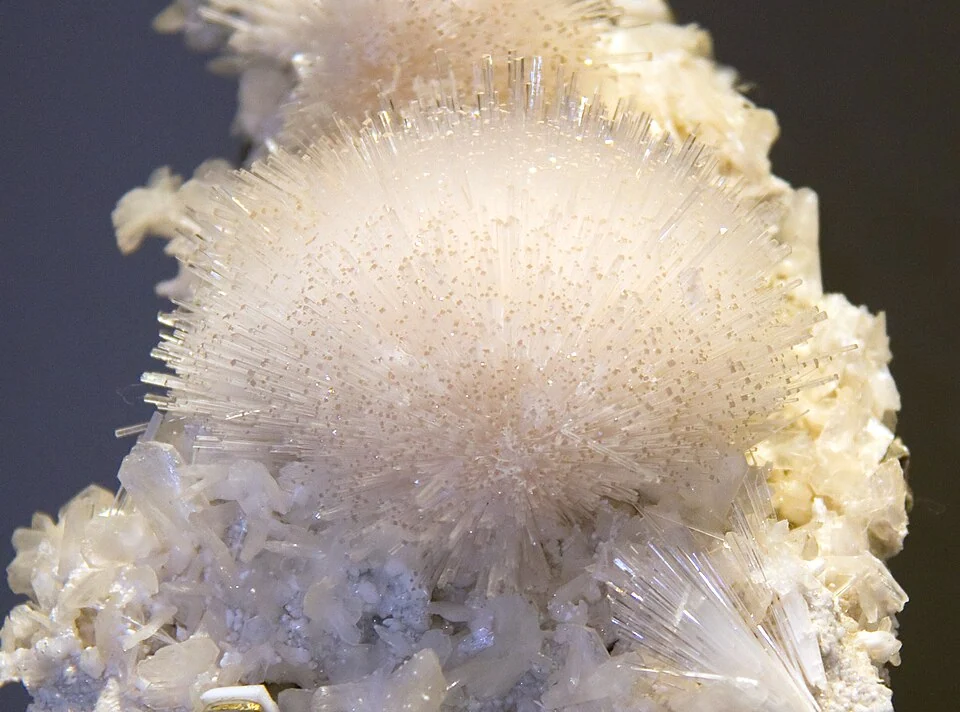
Look at the shapes, aggregates and colours of specimens from different collections.
Tony Hisgett from Birmingham, UK · CC BY 2.0 · WebP derivative
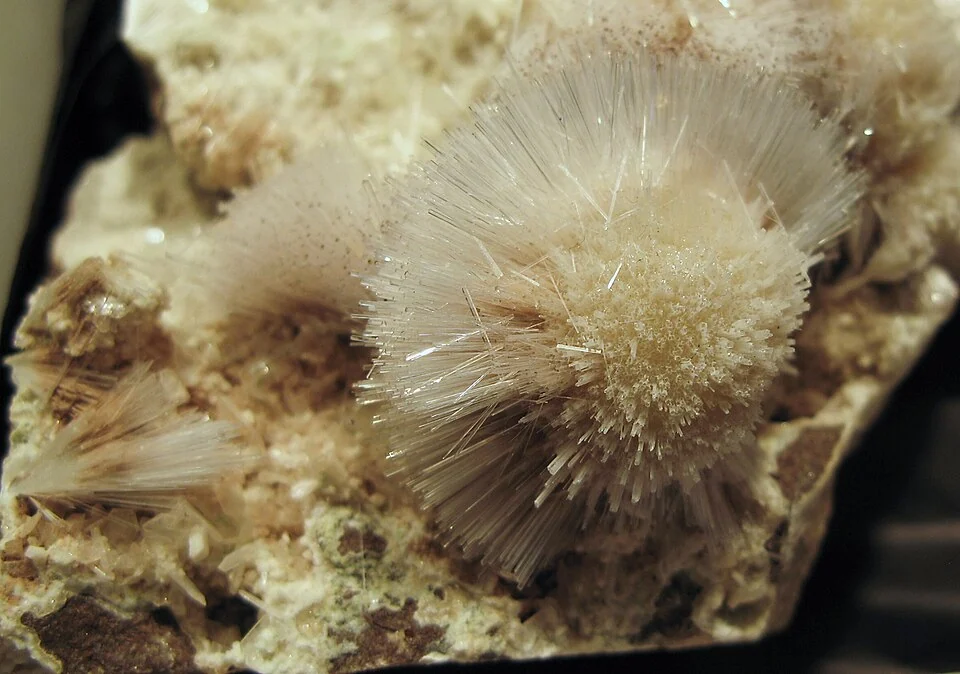
Ra'ike (see also: de:Benutzer:Ra'ike ) · CC BY-SA 3.0 · WebP derivative
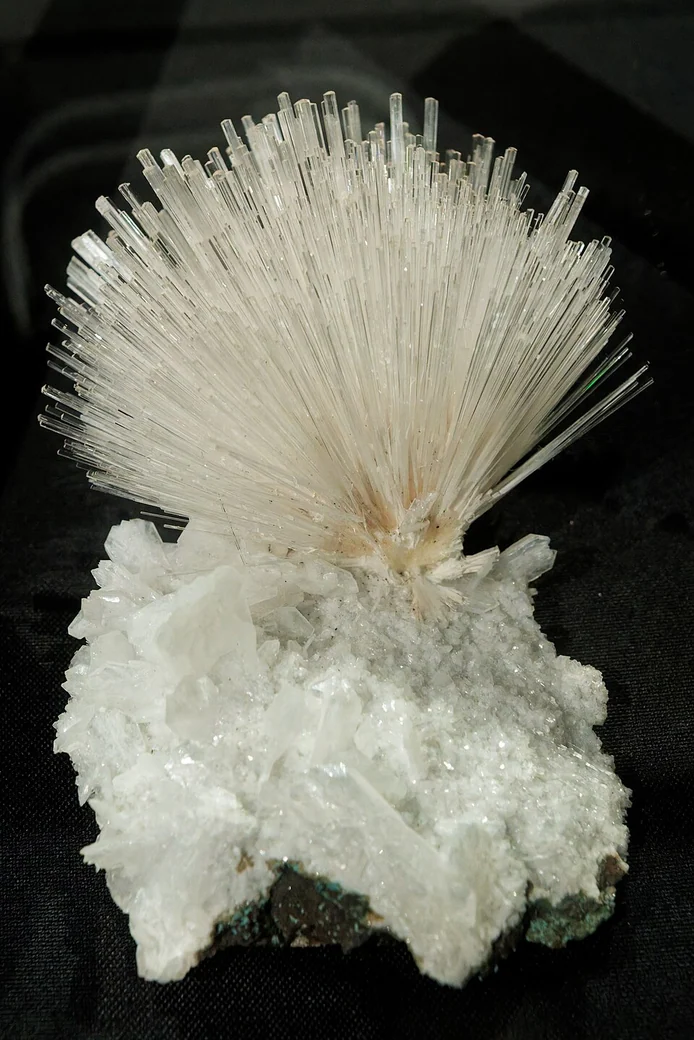
Marie-Lan Taÿ Pamart · ♪ 4.0 · WebP derivative
Study the mineral
How to identify it
It often forms cuffs of thin crystals, aghiforms or fibrosis, white and translucent, and fills cavities. The term “fibrose” describes the aggregate and does not automatically equal the category of asbestos.
How it forms
It is located in cavities of basaltic rocks and other volcanoes, along with zeoliths and calcite. The composition and growth relations distinguish mesolite from the nearby species of the group.
Uses and applications
Mesolite has mainly collectivistic and educational interest; it is not normally exploited as an industrial raw material. The zeolithic structure is relevant for research on ionic exchange, but does not authorize to transfer to the natural species the uses of every zeolite.
Laboratory question
The mesolite allows to observe acicular aggregates and to compare species similar to different sodium-calc ratios. Diffraction and microanalysis are necessary for identification when crystals are very fine.
Compare other minerals in the catalogue
Sources and further reading
See also the historical museum card
 - Na2Ca2[Alex]6Yes9O30]·8(H2O) -


MINERALOGICAL CLASS: Allumo-silicate
GROUP: Trimetric
SYSTEM: Rombique
SPACE GROUP: Fddd
EDGEMENT: {010} and {100}, characteristics.
ABITO: Extended, often fibrous or solid.
DUREZZA: 5
SPECIFIC PESO: 2,26
ROLE OF THE EUROPEAN COMMUNITIES=1.505 β=1.505 γ=1.505 δ=0.001
COLOURS: Colorful, white, grey, yellow
LIGHT: Vitreo
TRANSPARENCE: Transparent, glossy, matt
SFALDATURE: {110} {110}, perfect
STRISCIO: White
FRAME: Irregular
PLEOCROISMO:
GENESI: It forms in cavities of basaltic rocks.
JACIMENTS: United States, Australia, Africa india, China, Europe and generally in all basal regions.
HISTORY CENTRE: It was first found and described in 1816 in an island of the archipelago of the Farange of Cyclops, Sicily.
OTHER CHARACTERISTICS AND USE: It is part of the "family" of the Zeolites. It can be pyroelectric and piezielectric.
COMMENT: Radial aghiform samples can be curious pieces from collections.
EXPENDITURE CHAMPIONS TO MUSEUM:
STANCE:
TECA:
DESCRIPTION CAMPIONE: