
Marcasite
The brandy is iron sulphide, FeS₂, like pyrite, but crystallizes in the orthombique system instead of in the cubic one. It is therefore a distinct polymorph, not a variety of pyrites.
From specimen to structure
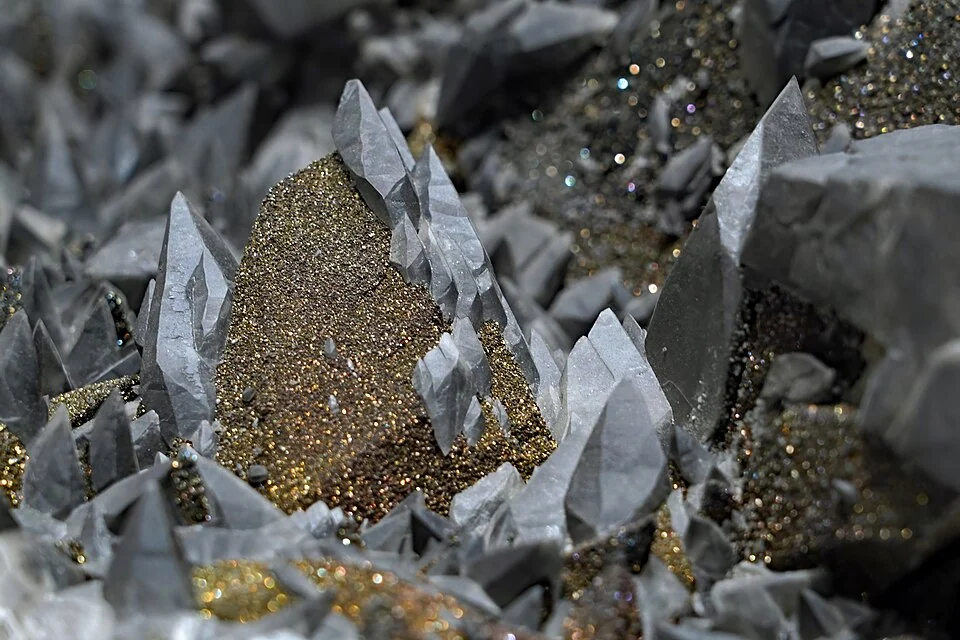
Aggregate chalk
Teaching reconstruction of the dress. Colours and surfaces illustrate the appearance of the mineral. Indicative dimensions.
Reference photograph · Ethmostigmus · CC BY-SA 4.0
Crystal unit cell
Coordinates of COD 9013067 diffraction. The spheres locate atomic sites and auctions highlight the vicinity in the cell.
In the COD sample the cell edges are a = 4,445 Å, b = 5,425 Å e c = 3,386 Å. The angles α, β and γ are respectively 90,00°, 90,00° and 90,00°.
Composition reported in the sample record ♪. Download the CIF · COD 9013067 · CC0
Elements and site occupancies in the unit cell
- Fe 2,00
- S 4,00
The totals are the sums of the site occupancies given in the CIF file.
Key data
- Class
- Sulphides and sulphosalts
- Reference formula
- FeS2
- Mohs hardness
- 6–6,5
- Observed form in the model
- Aggregate chalk
- COD sample space group
- P n n m
- Sites represented by cell
- 6
Specimen photographs
Look at the shapes, aggregates and colours of specimens from different collections.
Ethmostigmus · CC BY-SA 4.0 · WebP derivative

Robert M. Lavinsky · CC BY-SA 3.0 · WebP derivative
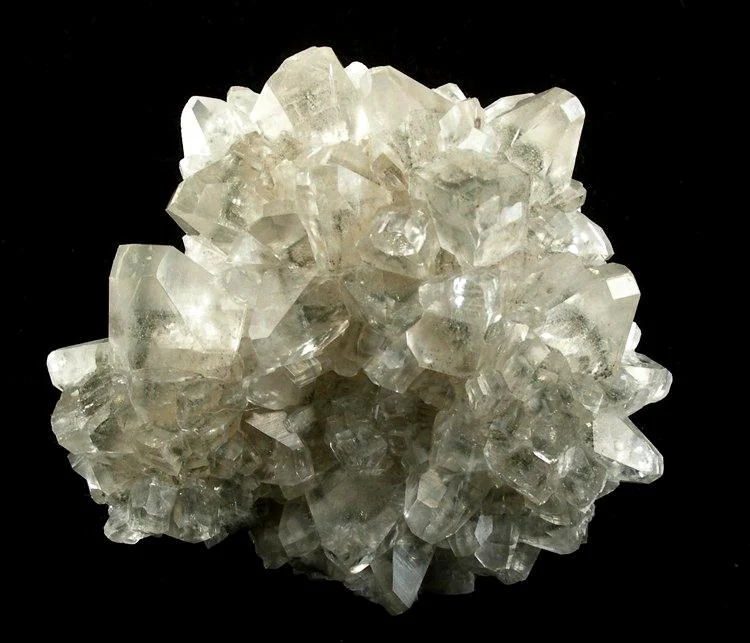
Robert M. Lavinsky · CC BY-SA 3.0 · WebP derivative
Study the mineral
How to identify it
It can appear pale bronze colour and form tabular crystals, comb crests or radiated nodules; the metallic aspect is not enough to distinguish it from the pyrite. The crystalline structure or a mineral examination is decisive in doubtful samples.
How it forms
It is often formed in sedimentary or low temperature conditions and can alter more easily than pyrite, producing sulphates and acidity. Nodules and aggregates to “paste of thunder” are dresses, not different species.
Uses and applications
Today it has mainly collectivistic and educational interest; the old ornamental processing does not make it a reliable source of iron. It is useful as a case to discuss stability and alteration of sulphides.
Laboratory question
The branded pair–pirite illustrates polymorphism: equal formula, symmetry and different stability. An altered sample allows to discuss why conservation and humidity affect the exposed sulphides.
Compare other minerals in the catalogue
Sources and further reading
See also the historical museum card
 - FeS2 -


MINERALOGICAL CLASS: Solfuro
GROUP: Trimetric
SYSTEM: Rombique
SPACE GROUP: Pnnm
EDGEMENT:
ABITO: Marcasite is formed as both primary and secondary mineral. As a primary mineral nodule form, concretions and tabular crystals, lamellars or prismatics. Very particular are some crystallizations in complex groups called to gall crest
DUREZZA: 5,5 - 6
SPECIFIC PESO: 4,6 - 4,9
ROLE OF THE EUROPEAN COMMUNITIES= 1,8
COLOURS: Bronze yellow or greenish grey.
LIGHT: Metallic
TRANSPARENCE: Opaque
SFALDATURE: separate {101}. Debts {110}
STRISCIO: Brass yellow
FRAME: Irregular
PLEOCROISMO: - Yes.
GENESI: As a primary mineral, it is typically formed in the areas of reduction from acid solutions where there are iron ions and sulphide ions (in case these solutions are alkaline, pyrite is deposited, otherwise if they are made neutral or weakly acidic, they are marked). The brandy can also be formed by hydrothermal deposition of low temperature. As a secondary mineral, it is formed by chemical alteration of minerals such as Pirite, Calcopirite and Pirrotite, which replaces as pseudomorphs.
JACIMENTS: The main places where it is possible to be branded are in Missouri (USA), Peru, South of England, in Saxony, Russia. In Italy you can find in the area of the Colline Metallifere and South Tuscany, typically as alteration of Pirite and other sulphides.
HISTORY CENTRE: In ancient times it was confused with pyrite (given almost identical colour and similar properties), in the Middle Ages it was used both as medicines; only in 1814, thanks to Haüy's studies, the branded pyrite was distinguished by its safety.
OTHER CHARACTERISTICS AND USE: Soluble in HCl; in HNO3 it decompones with insoluble residue. The brandy is metastabile, tends to disengage and oxidize quite quickly. It is not of particular economic importance, it is used as a raw material for the production of sulphuric acid.
COMMENT: Marcasite, oxidizing, can produce sulphuric acid. We must pay attention to the collections because there acid produced can corrode other samples, plates and bases of support.
EXPENDITURE CHAMPIONS TO MUSEUM:
STANCE:
TECA:
DESCRIPTION CAMPIONE: