
Erythrite
Eritritis is arseniato cobalt idrato, Co3(AsO4)₂·8H2O, and belongs to the group of vivianite. The nickname “cobalto bloom” describes the pink crusts that can form, not a different species.
From specimen to structure

Fibres or acicular aggregates
Teaching reconstruction of the dress. Colours and surfaces illustrate the appearance of the mineral. Indicative dimensions.
Reference photograph · Leon Hupperichs · CC BY-SA 3.0
Crystal unit cell
Coordinates of COD 5000227 diffraction. The spheres locate atomic sites and auctions highlight the vicinity in the cell.
In the COD sample the cell edges are a = 10,251 Å, b = 13,447 Å e c = 4,764 is the α, β and γ angles are 90,00°, 104,98° and 90,00° respectively.
Composition reported in the sample record ?. Download the CIF · COD 5000227 · CC0
Elements and site occupancies in the unit cell
- As 4,00
- Co 4,02
- Fe 1,48
- H 32,00
- Nina 0,50
- O 32,00
The totals are the sums of the site occupancies given in the CIF file.
Key data
- Class
- Phosphates, arsenates and vanades
- Reference formula
- Co3(SINGING)4)2·8H2O
- Mohs hardness
- 1,5–2,5
- Observed form in the model
- Fibres or acicular aggregates
- COD sample space group
- C 1 2/m 1
- Sites represented by cell
- 74
Specimen photographs
Look at the shapes, aggregates and colours of specimens from different collections.
Leon Hupperichs · CC BY-SA 3.0 · WebP derivative
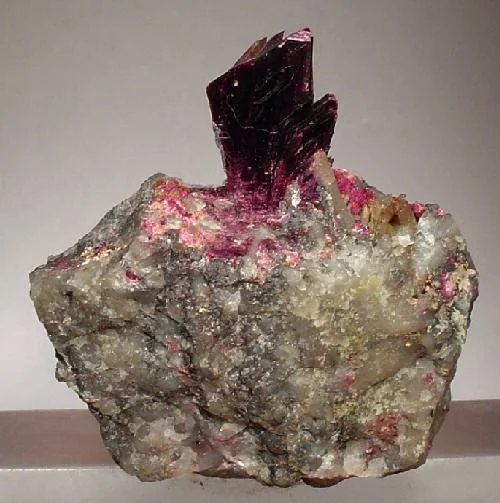
Robert M. Lavinsky · CC BY-SA 3.0 · WebP derivative

Osama Shukir Muhammed Amin FRCP(Glasg) · CC BY-SA 4.0 · WebP derivative
Study the mineral
How to identify it
The bright pink-violet, the acicular aggregates and the pulverulent crusts are typical characters; the colour is a clue, not a conclusive diagnosis. Cobalt and arsenic require to avoid contact, abrasion and dust.
How it forms
It is formed as a secondary product of the alteration of cobalt minerals in arsenic deposits, often with other arseniated. Chrosts can be thin and sensitive to manipulation.
Uses and applications
Eritritis is appreciated as a mineral indicator of the presence of cobalt and as a collector's sample; it is not a primary industrial source. It is not suitable for exercises with open samples or pigments.
Laboratory question
The species is useful for observing hydration, secondary arseniates and colour-composition association, with instrumental identification. The protected exposure communicates the risk of minerals containing arsenic and cobalt.
Compare other minerals in the catalogue
Sources and further reading
See also the historical museum card
 - Co.3[Sighs]4]2·8(H2O) -


MINERALOGICAL CLASS: Arseni
GROUP: Trimetric
SYSTEM: Monocline
SPACE GROUP: I 2/m
EDGEMENT:
Cprismatic acicular stalls with longitudinal striations. Frequently in radial or stellar aggregates, globular, dusty or terrosis.
DUREZZA: 1,5 - 2,5
SPECIFIC PESO: 3,2
ROLE OF THE EUROPEAN COMMUNITIES=(1.626-1.629) β=(1.662-1.663) γ=(1.699-1.701) δ=0.073
COLOURS: Red-porporpor, light red, purple
LIGHT: Adamantino, mother of pearly
TRANSPARENCE: Translucent
SFALDATURE: {010} Perfect
STRISCIO: Red light
FRAME:
PLEOCROISMO: Red, pink and violet.
GENESI: It is a secondary mineral characteristic of the areas of alteration of the Cobalto sulphite deposits.
JACIMENTS: Mexico, Morocco, Germany (Sassonia and Thuringia), Austria. In Italy in the territory of the municipality of Gonnosfanadiga, in the province of Cagliari and Pizzola, is located in Punta Corna and the Colle di Paschietto, in the Valli di Lanzo; in Primaluna, in the province of Como; in Monte Mulat, in Predazzo, in Trentino-Alto Adige; in the mine of Calamita and in the mine of the Ginevro of the island of Elba; in Sant'Acqua in Prunas, in the municipality of Gon Prunaspol, in the municipality of Gonnosfanadiga, in the province of Cagliari and in Gonnosfanadiga.
HISTORY CENTRE: The name comes from the Greek Erythros=red. First described by François Sulpice Beudant, a French geologist and mineralogist, in 1832.
OTHER CHARACTERISTICS AND USE: It dissolves in acids giving a red solution; in HNO3 instead gives a rosacea solution. Colour the light green flame; melts to the cannello forming a grey pearl and freeing an alleaceous smell while dehydrated and becomes blue. It is silky and flexible and always clean with distilled water. She has orange luminescence.
COMMENT: He's also known as the Flower of Cobalt and it is a rare mineral to find.
EXPENDITURE CHAMPIONS TO MUSEUM:
STANCE:
TECA:
DESCRIPTION CAMPIONE: