
Cinnabar
Cinnabar is mercury sulphide (HgS). Its crystals belong to the trigonal system. It was the main mercury ore mined on Monte Amiata.
From specimen to structure

Cinnabar specimen
A scan of a specimen in the digital collection. Rotate it to examine its shape and surface from every side.
Reference photograph · Robert M. Lavinsky · CC BY-SA 3.0
Mines Museum digital collection
Download the GLB modelCrystal unit cell
Diffraction coordinates from COD 9000004. The spheres mark atomic sites and the rods show neighbouring sites in the unit cell.
The model reproduces the structure published by Ramsdell in 1925. The unit-cell edges in the COD record are a = 4,150 Å, b = 4,150 Å and c = 9,510 Å. The angles α, β and γ are 90,00°, 90,00° and 120,00°, respectively.
The record gives the composition as HgS. Download the CIF · COD 9000004 · CC0
Elements and site occupancies in the unit cell
- Hg 3,00
- S 3,00
The totals are the sums of the site occupancies given in the CIF file.
Key data
- Class
- Sulphides and sulphosalts
- Reference formula
- HgS
- Mohs hardness
- 2–2,5
- Shape of the teaching model
- Prism with a trigonal cross-section
- Crystal system
- Trigonal, class 32
- Space groups
- P3₁21 or P3₂21
- Twinning
- Simple contact twins on {0001}
- Measured density
- 8,18 g/cm³
- Cleavage
- Perfect prismatic cleavage on {101̅0}
- Fracture and tenacity
- Subconchoidal or uneven fracture. Slightly sectile.
- Lustre
- Adamantine, tending towards metallic in dark specimens
- Optical properties
- Uniaxial positive. ω = 2,905 · ε = 3,256 · δ = 0,351
- Unit cell from Auvray and Genet (1973)
- a = b = 4,145 Å · c = 9,496 Å · Z = 3
- Space group in the COD record
- P3₂21
- Atomic positions in the unit-cell model
- 6
Specimen photographs
Look at the shapes, aggregates and colours of specimens from different collections.
Robert M. Lavinsky · CC BY-SA 3.0 · WebP derivative

JJ Harrison (https://www.jjharrison.com.au/ ) · CC BY-SA 3.0 · WebP derivative
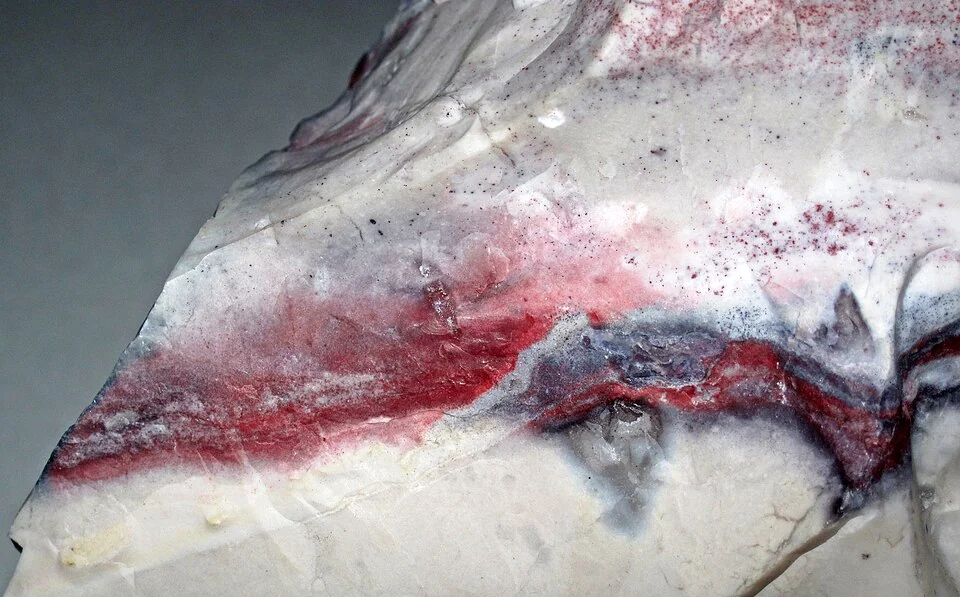
James St. John · CC BY 2.0 · WebP derivative
Study the mineral
How to identify it
The colour ranges from bright red to reddish brown and can be lead grey. The streak, or the colour of the powdered mineral, is scarlet. A given volume of cinnabar weighs about eight times as much as the same volume of water. It occurs in granular or compact masses and can form rhombohedral, tabular or prismatic crystals.
How it forms
Cinnabar is deposited from relatively cool mineral-rich waters circulating through fractures in the rock. It can occur alongside pyrite, marcasite, stibnite, realgar, calcite and forms of silica such as opal and chalcedony.
Uses and applications
Cinnabar is the natural source of vermilion, a red pigment. Wall paintings and ancient texts document its use as a colourant. It was also the main ore from which mercury was extracted.
Laboratory question
How can red cinnabar and black metacinnabar have the same formula? Use the model to see how the atoms repeat in the unit cell. Cinnabar, metacinnabar and hypercinnabar are polymorphs. They contain the same elements in the same proportions, with different arrangements of atoms.
Cinnabar on Monte Amiata
Shallow hydrothermal systems concentrated cinnabar in the Monte Amiata district. The district’s mines produced more than 100,000 tonnes of mercury, mainly between 1870 and 1980, according to the 2015 study by Rimondi and colleagues. The mineral in the history of Monte Amiata.
Examining the specimen
To study cinnabar, look at the specimens in the display case, the photographs and the models. Avoid creating dust or heating specimens that contain mercury.
Compare other minerals in the catalogue
Sources and further reading
Profile from the Museum’s historical website
Archive document retaining the terminology and data from the earlier edition. For the updated profile, see Key data.
 - HgS -


MINERALOGICAL CLASS: Solfuro
GROUP: Dimetric
SYSTEM: Trigonal
SPACE GROUP: P3121, P3221
EDGEMENT: Simple contact twins on {0001}
ABITO: Rarely prismatic or rhombohedral. More often massive, dispersed in the matrix or present as fine-grained earthy aggregates.
DUREZZA: 2 - 2,5
SPECIFIC PESO: 8,2
ROLE OF THE EUROPEAN COMMUNITIES=3,256 ω=2,905 δ=0,251
COLOURS: Red vermilion, brown, grey.
LIGHT: Adamantine
TRANSPARENCE: Transparent, translucent or matt.
SFALDATURE: {101̅0} perfect, rhombohedral
STRISCIO: Red
FRAME: Fragile, chipped.
PLEOCROISMO:
GENESI: Volcanic magmatic origin and hydrothermal veins, always at low temperatures.
JACIMENTS: Almaden (Spain), Monte Amiata (Tuscany), Slovenia. Other deposits are located in the United States, Peru, China where well crystallized cinaber is found.
HISTORY CENTRE: The cinnabar was used in the Roman Empire as a pigment and cosmetic and for the extraction of mercury. Other peoples in faraway regions have also often used this mineral as pigment (Maya in Latin America, Chinese and other Asian peoples).
OTHER CHARACTERISTICS AND USE: It's the mineral from which Mercury is extracted. Until a few decades ago, the mines of Chinabro were active and produced a large amount of this metal. Mercury was used in various industrial processes, for the production of many electronic strimentations, and other uses. With the discovery of its high toxicity, its use has declined considerably to the point of closing many of the mines from which the mineral was extracted. Among them also the mines of the Amiata, which were second producers of Mercury in the world after the Spanish ones of Almaden.
COMMENT: Although it does not have crystalline, the cinnabar is easy to recognize for its characteristic red greenish colour and for the high specific weight that characterizes it.
EXPENDITURE CHAMPIONS TO MUSEUM:
STANCE:
TECA:
DESCRIPTION CAMPIONE: