
Epidote
The epidote is a calcium and aluminium sorosilicate with ferric iron variable in the structure. The replacement of iron with aluminium changes the colour and composition, without turning any variation into a different species.
From specimen to structure

Prisma
Teaching reconstruction of the dress. Colours and surfaces illustrate the appearance of the mineral. Indicative dimensions.
Reference photograph · Paul Christian B. Yang-ed · CC BY-SA 4.0
Crystal unit cell
Coordinates of COD 9014101 diffraction. The spheres locate atomic sites and rods highlight the vicinity in the cell.
In the COD sample the cell edges are a = 8,882 Å, b = 5,654 Å e c = 10,163 is the α, β and γ angles are 90,00°, 115,44° and 90,00° respectively.
Composition reported in the sample record Al2.08 Ca2 Fe0.39 H Mn0.53 O13 Si3. Download the CIF · COD 9014101 · CC0
Elements and site occupancies in the unit cell
- Al 4,16
- Ca 4,00
- Fe 0,78
- Mnh 1,06
- O 26,00
- Yes 6,00
The totals are the sums of the site occupancies given in the CIF file.
Key data
- Class
- Silicates
- Reference formula
- Ca2Al2Fe3+(Si)2O7)(YO)4)O(OH)
- Mohs hardness
- 6–7
- Observed form in the model
- Prisma
- COD sample space group
- P 1 21/m 1
- Sites represented by cell
- 42
Specimen photographs
Look at the shapes, aggregates and colours of specimens from different collections.
Paul Christian B. Yang-ed · CC BY-SA 4.0 · WebP derivative
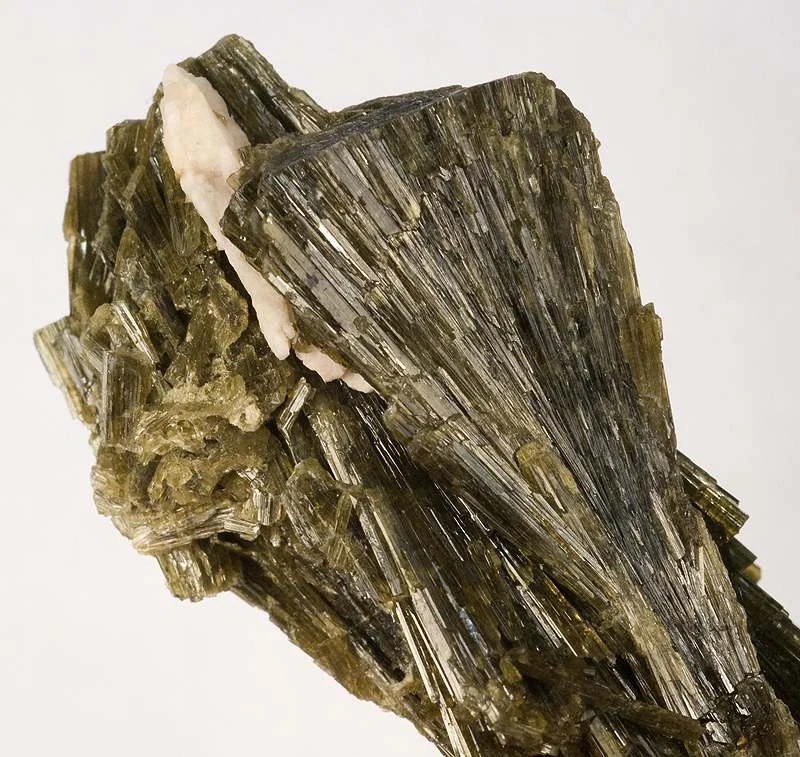
Robert M. Lavinsky · CC BY-SA 3.0 · WebP derivative

Moreau.henri · CC BY-SA 4.0 · WebP derivative
Study the mineral
How to identify it
The pistachio green is frequent, along with striated prismatic crystals and marked shade; colour and dress remain clues, not a diagnosis. In subtle section the strong relief and pleocroism can help to recognize it.
How it forms
It is common in low-grade metamorphic rocks, in skarn and in hydrothermal veins, often associated with chlorite, albite and amphibula. It can also be produced by alteration of plagioclase rich in calcium.
Uses and applications
The epidote has mainly collectors’ and petrological value; it is not an important industrial raw material. The well-developed crystals serve to show how metamorphosm and fluids transform mineral associations.
Laboratory question
In petrography, the epidote helps to read conditions of metamorphism and alteration; they compare colour, relief, blur and host rock context. The composition is determined by microanalysis, not by the green colour alone.
Compare other minerals in the catalogue
Sources and further reading
See also the historical museum card
 - Ca2Al2O.(Al.,Fe3+)OH[Si]2O7♪4] -


MINERALOGICAL CLASS: Silicato
GROUP: Trimetric
SYSTEM: Monocline
SPACE GROUP: P21/m
EDGEMENT: (100) Lamellar, uncommon.
ABITO: It is present in elongated prismatic crystals with frequent striations and also in fibrous aggregates
DUREZZA: 6
SPECIFIC PESO: 3,38 - 3,49
ROLE OF THE EUROPEAN COMMUNITIES=(1,715-1,751) β=(1,725-1,784) γ=(1,734-1,797) δ=(0,015-0,051)
COLOURS: Green, yellow, grey
LIGHT: From vitreous to resinous
TRANSPARENCE: From transparent to matt
SFALDATURE: {001) Perfect
STRISCIO: Light grey
FRAME: Irregular
PLEOCROISMO: Colorful to yellowish-green
GENESI: It is a mineral mainly metamorphic that comes into marbles and rocks.It is formed also in hydrothermal environment for alteration of various mineral components igneous rocks (Anfiboli, Pirosseni, Granati, miche and feldspar).
JACIMENTS: Austria, Connecticut and Alaska (USA), Norway, Brazil, Italy (famous Piedmontese, from which a mineral of this group takes the name "Piemontite").
HISTORY CENTRE: Discovered by R. J. Haüy, René (1743-1822) who, in 1801 gave him the name of epidote (from the Greek epidosis=growth), as the base of the prism has a longer side than the other
OTHER CHARACTERISTICS AND USE: It's fluorescent. It is used as a collector's mineral and rarely cut for gemmologic purposes (especially the crystals from the brazil). For ornamental purposes, a green and pink rock, called unkite, is used, which is formed by epidote (green) and feldspar (pink)
COMMENT: In hydrothermal environments it is generally beautifully diffused. It is easily recognized by colour and often by form, especially if it is of alteration on other pre-existing minerals.
EXPENDITURE CHAMPIONS TO MUSEUM:
STANCE:
TECA:
DESCRIPTION CAMPIONE: