
Heulandite (group; species not specified)
Heulandite is the name of a zeolite of the group of heulandite; in the historical nomenclature the name was also used for different compositions, while the modern distinction considers the species and the dominant cation. In the absence of analysing the board, the profile retains the legacy name without attributing a compositional suffix.
From specimen to structure
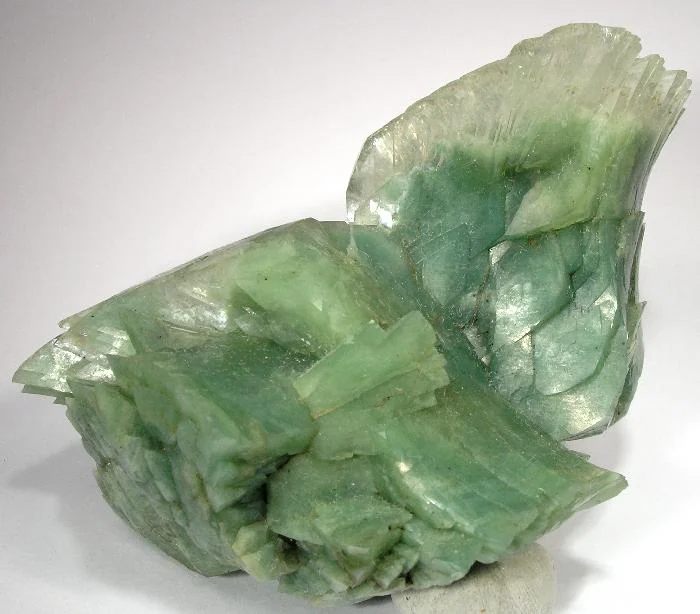
Lamellar crystals
Teaching reconstruction of the dress. Colours and surfaces illustrate the appearance of the mineral. Indicative dimensions.
Reference photograph · Robert M. Lavinsky · CC BY-SA 3.0
Crystal unit cell
Coordinates of COD 9005479 diffraction. The spheres locate atomic sites and auctions highlight the vicinity in the cell.
Reference sample chosen for this tab: Heulandite-Ca, a species of the series of heulandite.
In the COD sample the cell edges are a = 17,729 Å, b = 17,909 Å e c = 7,433 Ã α, β and γ angles are respectively 90,00°, 116,52° and 90,00°.
Composition reported in the sample record Al4.46 Ba0.015 Ca1.325 H26 K0.2 Na0.86 O49 Si13.54 Sr0.435. Download the CIF · COD 9005479 · CC0
Elements and site occupancies in the unit cell
- Al 8,92
- Ba 0,03
- Ca 2,65
- K 0,40
- Nana 1,72
- O 98,00
- Yes 27,08
- Sr. 0,87
The totals are the sums of the site occupancies given in the CIF file.
Key data
- Class
- Silicates
- Reference formula
- Ca(Al2Yes7O18)·6H2O
- Mohs hardness
- 3,5–4
- Observed form in the model
- Lamellar crystals
- COD sample space group
- C 1 2/m 1
- Sites represented by cell
- 142
Specimen photographs
Look at the shapes, aggregates and colours of specimens from different collections.
Robert M. Lavinsky · CC BY-SA 3.0 · WebP derivative

Robert M. Lavinsky · CC BY-SA 3.0 · WebP derivative

Robert M. Lavinsky · CC BY-SA 3.0 · WebP derivative
Study the mineral
How to identify it
Shape lamella and tabular crystals often with wedge contour, sometimes arranged in fan or cavity; it is relatively tender. Colour and shape do not allow to determine the dominant cation.
How it forms
It is common in cavities of volcanic rocks and in tufi altering products, often with other zeolites and calcite. The water hosted in the canals can be lost in part during heating or dehydration.
Uses and applications
Heulandite is especially appreciated as a sample and for the study of natural zeolites; adsorption applications are more often developed on selected or synthetic materials. A non-characteristic sample should not be presented as a specific chemical variety.
Laboratory question
It is useful to observe tabular crystals and discuss ion exchange and dehydration in zeolites. The composition should be measured to assign any suffixes of species according to the current nomenclature.
Compare other minerals in the catalogue
Sources and further reading
See also the historical museum card
 - (Chuckles)2,K2)4[Alex]8Yes28O72].24(H2O) -


MINERALOGICAL CLASS: Allumo-silicate
GROUP: Trimetric
SYSTEM: Monocline
SPACE GROUP: Cm
EDGEMENT:
ABITO: Tabular, lamellar, trapezoidal and more rarely prismatic and acicular. It also presents itself in the form of aggragates in radiant lamellas and incrustations
DUREZZA: 3 - 3,5
SPECIFIC PESO: 2,2
REFRATION INDEX: α=(1.476-1.506) β=(1.479-1.510) γ=(1.479-1.517) δ=(0.003-0.011)
COLOURS:colour, white, grey, green, pink, yellow, reddish, brownish until black
LIGHT: From vitrea to madreperlacea
TRANSPARENCE: Transparent or translucent
SFALDATURE: {010} Perfect
STRISCIO: White
FRAME: Irregular
PLEOCROISMO:
GENESI: It forms in various geological environments: volcanic, low-grade metamorphic, pegmatitic, diagenetic (semination of sediments, typically marine, which undergoes processes of compaction and formation of sedimentary rocks)
JACIMENTS: India (Zeolites of Poona), Iceland, USA (many locality), Canada, Brazil, Iran, Australia, New Zealand, Scotland, Germany, Russia. In Italy is present heulandite in Sardinia
HISTORY CENTRE: Fu first described in 1822 by the crystallographer H.J. Brook named her heulandite in honor of J.H. Heuland, a well-known British collector; previously heulandite was confused with the Stilbite.
OTHER CHARACTERISTICS AND USE: It's part of the family Zeolites. Currently heulandite is used as a filter in the chemical industry and as a collector's mineral
COMMENT: Thanks to the dress, the perfect shade, density and gloss can be recognized by the heulandite; very beautiful are the samples from Poona (Deccan, India)
EXPENDITURE CHAMPIONS TO MUSEUM:
STANCE:
TECA:
DESCRIPTION CAMPIONE: