
Hemimorphite
Hemimorphite is a zinc-hydrated silicate, Zn4Si2O7(OH)₂·H2O, belonging to the surosilicates. The name recalls the different termination of the two heads of some crystals, a character linked to the hemimorphic symmetry.
From specimen to structure

Lamellar crystals
Teaching reconstruction of the dress. Colours and surfaces illustrate the appearance of the mineral. Indicative dimensions.
Reference photograph · Robert M. Lavinsky · CC BY-SA 3.0
Crystal unit cell
Coordinates of COD 1566343 diffraction. The spheres identify atomic sites and rods highlight the vicinity in the cell.
In the COD sample the cell edges are a = 8,368 Å, b = 10,724 Å e c = 5,112 is the α, β and γ angles are 90,00°, 90,00° and 90,00° respectively.
Composition reported in the sample record H4 O10 Si2 Zn4. Download the CIF · COD 1566343 · CC0
Elements and site occupancies in the unit cell
- O 20,00
- Yes 4,00
- Z 8,00
The totals are the sums of the site occupancies given in the CIF file.
Key data
- Class
- Silicates
- Reference formula
- Z4(Sighs)2O7(OH)2·H2O
- Mohs hardness
- 4,5–5
- Observed form in the model
- Lamellar crystals
- COD sample space group
- I m m 2
- Sites represented by cell
- 32
Specimen photographs
Look at the shapes, aggregates and colours of specimens from different collections.
Robert M. Lavinsky · CC BY-SA 3.0 · WebP derivative
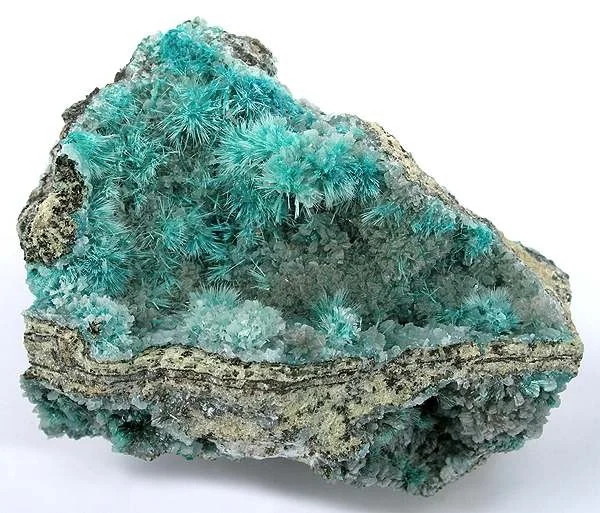
Robert M. Lavinsky · CC BY-SA 3.0 · WebP derivative

Robert M. Lavinsky · CC BY-SA 3.0 · WebP derivative
Study the mineral
How to identify it
It can form tabular crystals, botrioid crusts, granular masses and ray aggregates, often incolored, white or blue. It is more tender than many silicates and can resemble other secondary minerals of zinc.
How it forms
It forms in the oxidized zones of zinc deposits, often with smithsonite, willemite and limonite. Its presence documents the transformation of primary sulphides during circulation of water and oxygen.
Uses and applications
It was a secondary resource of zinc in some stores, but today it is mainly a mineral sample and an alteration indicator. Industrial materials are derived from mineral selection and treatment processes.
Laboratory question
The hemimorphite shows how crystalline symmetry is reflected in the termination of the crystals and how water and silica enter the secondary phases. The comparison with smithsonite distinguishes a silicate idrated by a zinc carbonate.
Compare other minerals in the catalogue
Sources and further reading
See also the historical museum card
 - Zn.4[Sighs]2O7](OH)2·H2O-


MINERALOGICAL CLASS: Silicate
GROUP: Trimetric
SYSTEM: Rombique
SPACE GROUP: Imm2
EDGEMENT: Rare
ABITO: Tabulars, botroid, aggregates and crusts, granulars and terrosis.
DUREZZA: 4,5 - 5
SPECIFIC PESO: 3,48
ROLE OF THE EUROPEAN COMMUNITIES=1.614 β=1.617 γ=1.636 δ=0.022
COLOURS: Colorful, bainque, light blue, light green, grey, brown
LIGHT: Adamantino, glassy, pearly.
TRANSPARENCE: Transparent, translucent
SFALDATURE: {110} Perfect
STRISCIO: White
FRAME: Irregular, sub-concoid
PLEOCROISMO:
GENESI: Hemimorphite is a mineral of secondary origin that is formed in the area of alteration of the deposits of Piombo and Zinco.
JACIMENTS: Pennsylvania, Missouri, Montana, Colorado, Oregon, New Mexico (USA); North Africa,Tailandia, Siberia, Poland, Slovenia; Cary, Austria, England. In Italy it is located in Sardinia.
HISTORY CENTRE: It is often associated with Smithsonite (a Zinco carbonate) with which he was first confused in the jaciemnts at Piombo-Zinco. Only in the second half of the '700 It was discovered that it was two different minerals.
OTHER CHARACTERISTICS AND USE: is pyroelectric and fluorescent, with blue tones when exposed to UV rays. It is an important mineral for the extraction of the Zinc, with mineral content greater than 50%.
COMMENT: The name Emimorfite is associated with the shape of the mineral itself that develops crystalline faces similar to each other.
EXPENDITURE CHAMPIONS TO MUSEUM:
STANCE:
TECA:
DESCRIPTION CAMPIONE: