
Albite
The albite is the sodium term of plagioclasic feldspars, NaAlSi3O8, and forms a continuous series with the anorthetis, rich in calcium. “Plagioclase” indicates the series of feldspars, not a species separated from the albite.
From specimen to structure

Lamellar crystals
Teaching reconstruction of the dress. Colours and surfaces illustrate the appearance of the mineral. Indicative dimensions.
Reference photograph · Rock Currier · CC BY 3.0
Crystal unit cell
Coordinates of COD 9009663 diffraction. The spheres locate atomic sites and auctions highlight the vicinity in the cell.
In the COD sample the cell edges are a = 8,146 Å, b = 12,797 Å e c = 7,158 Å. The angles α, β and γ are 94,25°, 116,60° and 87,80° respectively.
Composition reported in the sample record Al1.02 Ca0.02 Na0.98 O8 Si2.98. Download the CIF · COD 9009663 · CC0
Elements and site occupancies in the unit cell
- Al 4,08
- Ca 0,08
- Nana 3,92
- O 32,00
- Yes 11,92
The totals are the sums of the site occupancies given in the CIF file.
Key data
- Class
- Silicates
- Reference formula
- NaAlSi3O8
- Mohs hardness
- 6–6,5
- Observed form in the model
- Lamellar crystals
- COD sample space group
- C -1
- Sites represented by cell
- 52
Specimen photographs
Look at the shapes, aggregates and colours of specimens from different collections.
Rock Currier · CC BY 3.0 · WebP derivative

Hannes Grobe/AWI · CC BY-SA 4.0 · WebP derivative
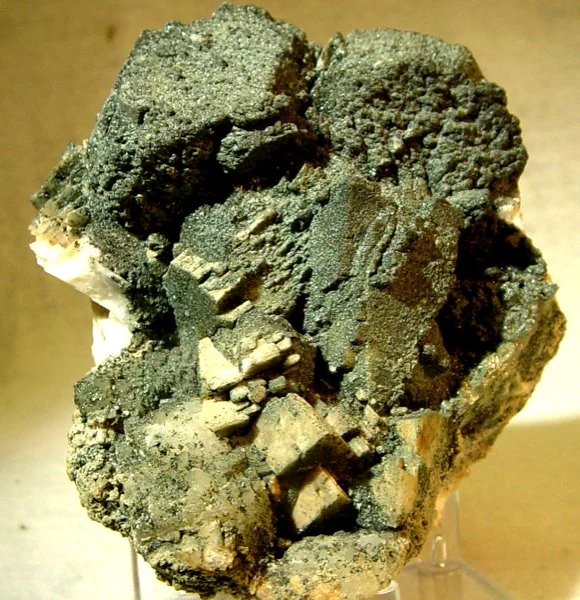
Robert M. Lavinsky · CC BY-SA 3.0 · WebP derivative
Study the mineral
How to identify it
It is often white or colourless, with two almost orthogonal nuances and parallel twinnings that can produce streaks on the surfaces. The geminations and composition distinguish it from potassic feldspars, but the visible identification can be uncertain.
How it forms
Albite is common in igneous, metamorphic and pegmatitic rocks and can grow as crystals or as potassic feldspar lamella. The compositions of plagioclase reflect Na-Ca relationships and training conditions.
Uses and applications
Albite contributes to feldspar raw materials for glass and ceramics; its industrial uses depend on the characteristics of rock and composition. Crystals are also teaching samples for gemination and solid series.
Laboratory question
The chalming streaks and the Na-Ca composition allow the introduction of the plagioclase series. Optical and chemical analysis distinguish albite from orthoclase and more calcic plagioclase.
Compare other minerals in the catalogue
Sources and further reading
See also the historical museum card
 - Na[AlSi]3O8] -


MINERALOGICAL CLASS: Allumo-silicate
GROUP: Trimetric
SYSTEM: Triclino
SPACE GROUP: C1
EDGEMENT: Crystals are almost always geminated, usually like Albite-Calsbad. In many cases these geminations are  reflect macroscopically with streaks along the faces of the crystal.
ABITO: It always has crystalline, euedral or subheudral, with prismatic crystals of various sizes depending on the environment in which it forms (from macrocrystalline, with crystals up to 15 cm to microcrystalline, with crystals not visible to the naked eye)
DURANCE: 6 - 6,5
SPECIFIC PESO: 2,6
ROLE OF THE EUROPEAN COMMUNITIES=(1.528-1.533) β=(1.532-1.537) γ=(1.538-1.542) δ=0.010
COLOURS: Colorful, white, yellow, green, brown, black
LIGHT: Vitrea
TRANSPARENCE: Transparent, translucent, matte
SFALDATURE: {001} perfect, {010} good
STRISCIO: White
FRAME: Irregular
PLEOCROISMO: Colour
GENESI: Main constituent of granite rocks. It is present in a wide variety of other magnatic rocks. It is also found in pegmatitic veins and in metamorphic rocks (filladi, Micascisti, gnaiss).
JACIMENTS: It is located wherever there are magmatic and metamorphic rocks described above.
HISTORY CENTRE: The discovery took place in 1815 in Sweden. albus=white due to the typical colour that presents the mineral.
OTHER CHARACTERISTICS AND USE: It is one of the main minerals that make up the Crosta Terrestre, being this formed mainly by granite rocks. It's one of the two chemical terms of the Plagioclasus, a chemical series formed by Albite-Anortite. Albite is the term sodium (acid), L'Anortite il term calcico (Ca)2Yes2O8]}. Both form solid solutions with Orthoclase. While it is generally possible to distinguish Ortoclase crystals from Plagioclase crystals (not always), even with a naked eye, it is impossible to distinguish the two Plagioclase if not through analysis in optical microscope or chemical analysis.
COMMENT: It's a little everywhere and the crystals are usually well formed. However, it is not so easy to find large transparent collectors.
EXPENDITURE CHAMPIONS TO MUSEUM:
STANCE:
TECA:
DESCRIPTION CAMPIONE: