
Fluorite
Fluorete is calcium fluoride, CaF2, and crystallizes in the cubic system.It is the reference mineral for Mohs scale grade 4.
From specimen to structure

Cube
Teaching reconstruction of the dress. Colours and surfaces illustrate the appearance of the mineral. Indicative dimensions.
Reference photograph · James St. John · CC BY 2.0
Physics of Fluoretes
Paleontological Research Institution · Digital Atlas of Ancient Life · Emily Hauf
Crystal unit cell
Coordinates of COD 2300449 diffraction. The spheres locate atomic sites and rods highlight the vicinity in the cell.
In the COD sample the cell edges are a = 5,463 Å, b = 5,463 Å e c = 5,463 is the α, β and γ angles are 90,00°, 90,00° and 90,00° respectively.
Composition reported in the sample record Ca F2. Download the CIF · COD 2300449 · CC0
Elements and site occupancies in the unit cell
- Ca 4,00
- F 8,00
The totals are the sums of the site occupancies given in the CIF file.
Key data
- Class
- Alogenuri
- Reference formula
- CaF2
- Mohs hardness
- 4
- Observed form in the model
- Cube
- COD sample space group
- F m -3 m
- Sites represented by cell
- 12
Specimen photographs
Look at the shapes, aggregates and colours of specimens from different collections.
James St. John · CC BY 2.0 · WebP derivative
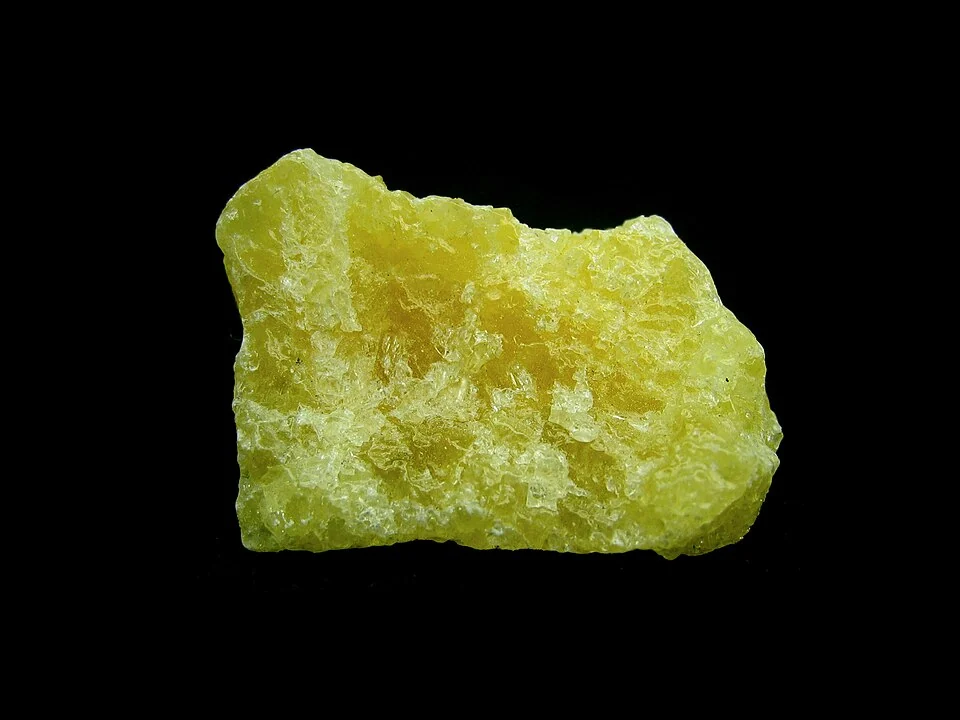
"Jon Zander (Digon3 )" · CC BY-SA 3.0 · WebP derivative

Photo by and (c)2015 Derek Ramsey ( Ram-Man) · CC BY-SA 4.0 · WebP derivative
Study the mineral
How to identify it
Cubic and octaedral crystals, octaedral blur and 4 hardness are useful characters; colour can vary widely or miss. Ultraviolet fluorescence is possible but not universal and does not define the species alone.
How it forms
It is located in hydrothermal veins and cavities, often with quartz, calcite and sulphites or sulphates. The colour zones can change during growth, but do not automatically indicate age or location.
Uses and applications
Fluorete is used as a metallurgical fuse and as a raw material for fluorine compounds; optically suitable varieties have been used in special lenses. Extraction and processing require dust controls and fluorinated compounds.
Laboratory question
The slenderness and hardness allow a comparative identification exercise, while fluorescence offers an example of luminescent linked to impurities and defects. UV testing should be conducted without looking directly at the source.
Compare other minerals in the catalogue
Sources and further reading
- Handbook of Mineralogy — Fluorite
- Schreyer, Martin; Guo, Liangfeng; Thirunahari, Satyanarayana; Gao, Feng; Garland, Marc (2014) · Simultaneous determination of several crystal structures from powder mixtures: the combination of X-ray diffraction, band-target entropy minimization and Rietveld methods
- Nomenclature and formulas · IMA–CNMNC
See also the historical museum card
 - CaF2 -


MINERALOGICAL CLASS: Alogenuro
GROUP: Monometric
SYSTEM: Cubico
SPACE GROUP: Fm3m
EDGEMENT: Frequent compulsion geminations {111}
ABITO: Fluorete forms often perfect euedral crystals, of habitus generally cubic. It can also be found in octaedric form and, rarely, dodecaedric.
DUREZZA: 4
SPECIFIC PESO: 3,18
ROLE OF THE EUROPEAN COMMUNITIES1,433
COLOURS: Pure fluorite is colourless, but usually it is purged and varied in vila (very typical), yellow, blue, green, red, pink, orange, brown, grey, black.
LIGHT: Vitrea
TRANSPARENCE: Polished or translucent. rarely opaque.
SFALDATURE: Perfect octaedric.
STRISCIO: white
FRAME: Irregular
PLEOCROISMO: - Yes.
GENESI: In nature fluorite is usually found in hydrothermal philns, often as a matrix of metal deposits where it is associated with lead, silver and zinc sulphides, and in cavities of metamorphic and magmatic rocks rich in silica.
JACIMENTS: Important deposits are located in the United States, Canada, Mexico, Germany, France, Spain, Russia, Switzerland, England, Madagascar. In Italy there are deposits in Val Trompia (Brescia), Trentino, Veneto and Sardinia. In Tuscany you can find yourself in association with the sulphur minerals of some metal mining areas.
HISTORY CENTRE: The name comes from the Latin fluere=fondere (for its use as a metallurgical founding). . The ancient Greeks cut it as precious stones, the Romans used it for the construction of beautiful multicolored vases. Fluorete then derives the name of fluoride and fluorescence.
OTHER CHARACTERISTICS AND USE: Some types exposed to ultraviolet rays have a showy fluorescence phenomenon, a phenomenon that is called by the mineral. It has a low refractive index, it isotropy, melts at 1330°C. About half of extremated fluorite is used in the production of useful fluoridation in the chemical, galvanotechnic industry and as a founding, preservative, fixing, propellent in spray packaging; the other half is used directly as a founding in the steel industry; a small percentage is used in the field of porcelain, glass, cement, as a enamel and as a component of optical instruments.
COMMENT: It is commonly found crystallized, in a wide variety of colours. Despite the beauty of the mineral and the perfect nuance, it is not commonly used as precious stone due to low hardness. It has greater hardness than Calcite but less than Quartz. It is, however, very appreciated as a collector's mineral.
EXPENDITURE CHAMPIONS TO MUSEUM:
STANCE:
TECA:
DESCRIPTION CAMPIONE: