
Calcite
The calcite is calcium carbonate, CaCO₃, and the most common of calcium carbonate polymorphs. Its trigonal structure produces a very characteristic romboedric nuances.
From specimen to structure

Physitics of calcite
A scan of a specimen in the digital collection. Rotate it to examine its shape and surface from every side.
Reference photograph · Daniel Ventura · CC BY-SA 3.0
Mines Museum digital collection
Download the GLB modelCrystal unit cell
Coordinates of COD 9014216 diffraction. The spheres locate atomic sites and auctions highlight the vicinity in the cell.
In the COD sample the cell edges are a = 4,976 Å, b = 4,976 Å e c = 17,432 is the α, β and γ angles are 90,00°, 90,00° and 120,00° respectively.
Composition reported in the sample record C Ca O3. Download the CIF · COD 9014216 · CC0
Elements and site occupancies in the unit cell
- C 6,00
- Ca 6,00
- O 18,00
The totals are the sums of the site occupancies given in the CIF file.
Key data
- Class
- Coal
- Reference formula
- CaCO3
- Mohs hardness
- 3
- Observed form in the model
- Romboedro
- COD sample space group
- R -3 c :H
- Sites represented by cell
- 30
Specimen photographs
Look at the shapes, aggregates and colours of specimens from different collections.
Daniel Ventura · CC BY-SA 3.0 · WebP derivative
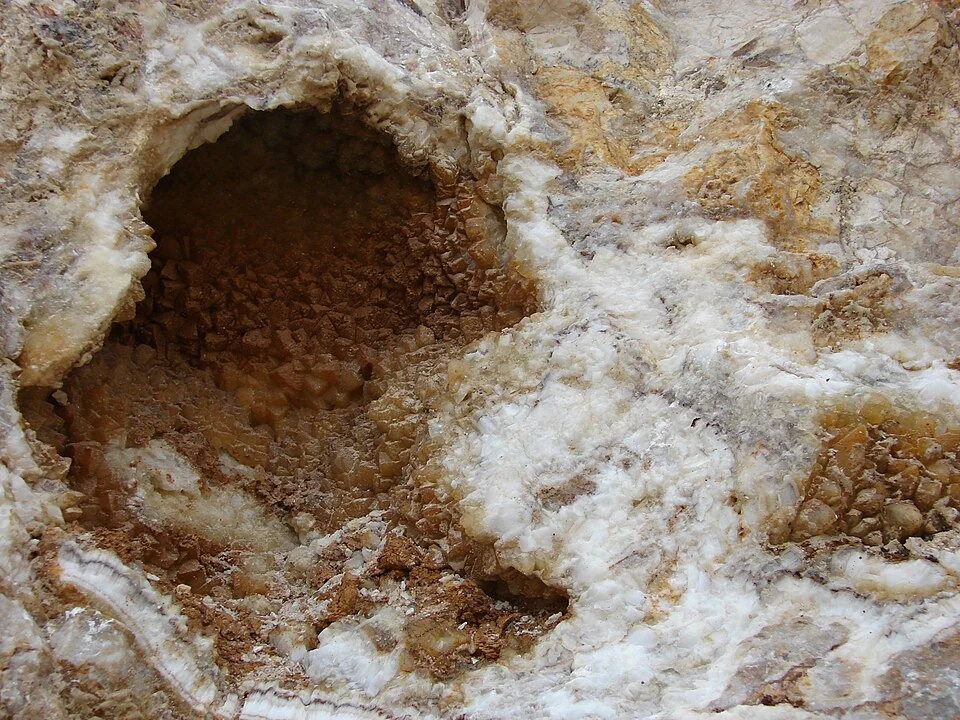
Patocsdori · CC BY-SA 4.0 · WebP derivative

Brocken Inaglory · CC BY-SA 3.0 · WebP derivative
Study the mineral
How to identify it
The hardness 3, the rumbohedral sleaching and the strong effervescence with diluted acid are practical clues; the double refraction is visible in transparent crystals suitable. Colour and dress vary and do not define species or origin.
How it forms
It is the main constituent of many limestones and marbles and also falls into stalactites, stalagmites and carbonatic cements. It can form compositional series and replacements, but the ideal sample remains CaCO₃.
Uses and applications
Calcitis and limestone rocks feed the production of lime and cement and are used as mineral charges; the choice depends on rock, purity and granulometria. Transparent crystals are also used in optical demonstrations.
Laboratory question
It is suitable for controlled tests on hardness, shearing, effervescence and bi-reflection. The comparison with aragonite shows that the same chemical composition does not imply the same structure.
Compare other minerals in the catalogue
Sources and further reading
- Handbook of Mineralogy — Calcite
- Antao, S. M.; Hassan, I. (2010) · Temperature dependence of the structural parameters in the transformation of aragonite to calcite, as determined from in situ synchrotron powder X-ray-diffraction data Note: T = 662 C Note: P = 101 kPa
- Nomenclature and formulas · IMA–CNMNC
See also the historical museum card
 - Ca[CO]3] -


MINERALOGICAL CLASS: Carbonate
GROUP: Dimetric
SYSTEM: Trigonal
SPACE GROUP: R3c
EDGEMENT: {0112} lamellar, very common; {0001} common.
ABITO: In the crystalline form it presents rhomboedric, laddernohedra, hexagonal prismatic and various combinations between them, always respecting the symmetry of the trigonal system. Frequent cases of gemination. The calcite is still found in many other microcrystalline forms due to the many environments in which it can form (in particular sedimentary and as precipitated by hydrothermal fluids ""The" which can give massive or vacucular forms., stalactitic and stalagmitic. Other sedimentary environments can give fibrous, nodulary, oolithic, dendritic, granular forms, in layers and in a thousand other ways (including numerous cases of pseudomorphism due to the transformation of Aragonite into Calcite).
DUREZZA: 3
SPECIFIC PESO: 2,71
ROLE OF THE EUROPEAN COMMUNITIES=1,486 - (1.550) ω= 1.658 - (1.740) δ = 0.172 - (0.190). The values in brackets are related to non-pure calcite. The calcite has a very high refraction index, so that it can double a radius that crosses a transparent crystal, making the bi-refraction visible even to the naked eye.
COLOURS: Typically colourless or white.If it has impurities it can give rise to a multitude of different shades, from red, pink, orange, brown, yellow, green, grey, black and others.
LIGHT: Vitrea; dusty in mass samples.
TRANSPARENCE: From transparent to translucent and also matte.
SFALDATURE: Romboedric Perfection
STRISCIO: White powder
FRAME: Irregular in creistalli. Concoid in mass aggregates.
PLEOCROISMO: - Yes.
GENESI: Typical mineral of sedimentary origin, both for chemical precipitation direct from evaporation of oversaturated solutions, and for sedimentation of organic remains of marine organisms that use calcium carbonate as constituent their shell.
It can also originate in metamorphic and magmatic rocks. In geothermal environment, hot fluids circulated between the rocks can contain considerable amounts of dissolved cacio carbonate (in solution) which precipitates giving rise to calcareous incrostations as soon as the pressure and temperature surface environment are reached. A note should be reported for the "Marmi", rocks of Termo-Metamorphic origin due to the transformation of limestone rocks due to a heating for contact. This type of metamorphism allows the crystals that make up the limestone matrix of the original rock to grow in size, finally giving a larger grain matrix where the calcite creistalli can also be recognized to the naked eye.
JACIMENTS: The calcite is located a little everywhere, but the environments where beautiful crystals can be found are typically those in which there has been a deposition due to precipitation from hydrothermal fluids, often associated with other mineralizations.
HISTORY CENTRE: The name comes from the Latin term calx which means lime. The history of this mineral does not only involve the evolution of man, but more generally calcite is a mineral fundamental to the world's marine ecosystem. Many molluscs have a jischio (or shell) formed by calcite (or aragonite). The calcite was used in the past as an optical instrument.
OTHER CHARACTERISTICS AND USE: It has two polymorphic minerals (chemical composition but different crystalline structure): Aragonte and Vaterite ( calcite is trigonal, orthorombic aragonitis and hexagonal vaterites); it exists in various forms and is generated in various environments. It is strongly bi-reflective, effervescent with attack with acids, presents the phenomenon of fluorescence (if subjected to ultraviolet rays, with red, yellow, pink and blue colorations), phosphorescent and thermoluminescence. The calcite has many industrial applications, among them are the production of cements, ceramics and in the paper industry, glassware, steel, chemical and optical (for its particular properties, once almost all polarizers were made with calcite); it is also used for the construction of ornamental objects and sold as a collector's mineral and used in crystal therapy.
COMMENT: The calcite is very well recognized thanks to the perfect phasing, the high bi-reflection and the strong reaction with even weak acids (other carbonates such as dolomite and siderite do not react so easily). It is a very diffuse mineral and can present various colours due to crystalline impurities.
EXPENDITURE CHAMPIONS TO MUSEUM:
STANCE:
TECA:
DESCRIPTION CAMPIONE: