
Ludwigite
The ludwigite is a complex borate of magnesium and iron, with ideal formula Mg2Fe3+BO5. It may contain substitutes between magnesium, iron and other cations, to be evaluated with chemical analysis.
From specimen to structure

Fibres or acicular aggregates
Teaching reconstruction of the dress. Colours and surfaces illustrate the appearance of the mineral. Indicative dimensions.
Reference photograph · Robert M. Lavinsky · CC BY-SA 3.0
Crystal unit cell
Coordinates of COD 9014098 diffraction. The spheres identify atomic sites and rods highlight the vicinity in the cell.
In the COD sample the cell edges are a = 9,260 Å, b = 12,294 Å e c = 3,024 is the α, β and γ angles are 90,00°, 90,00° and 90,00° respectively.
Composition reported in the sample record Al0.2 B2 Fe1.404 Mg3.976 O10 Ti0.42. Download the CIF · COD 9014098 · CC0
Elements and site occupancies in the unit cell
- Al 0,40
- B 4,00
- Fe 2,81
- Mg 7,95
- O 20,00
- You're the one 0,84
The totals are the sums of the site occupancies given in the CIF file.
Key data
- Class
- Boratia
- Reference formula
- Mg2Fe3+O2(BOTHING)3)
- Mohs hardness
- 5
- Observed form in the model
- Fibres or acicular aggregates
- COD sample space group
- P b a m
- Sites represented by cell
- 36
Specimen photographs
Look at the shapes, aggregates and colours of specimens from different collections.
Robert M. Lavinsky · CC BY-SA 3.0 · WebP derivative
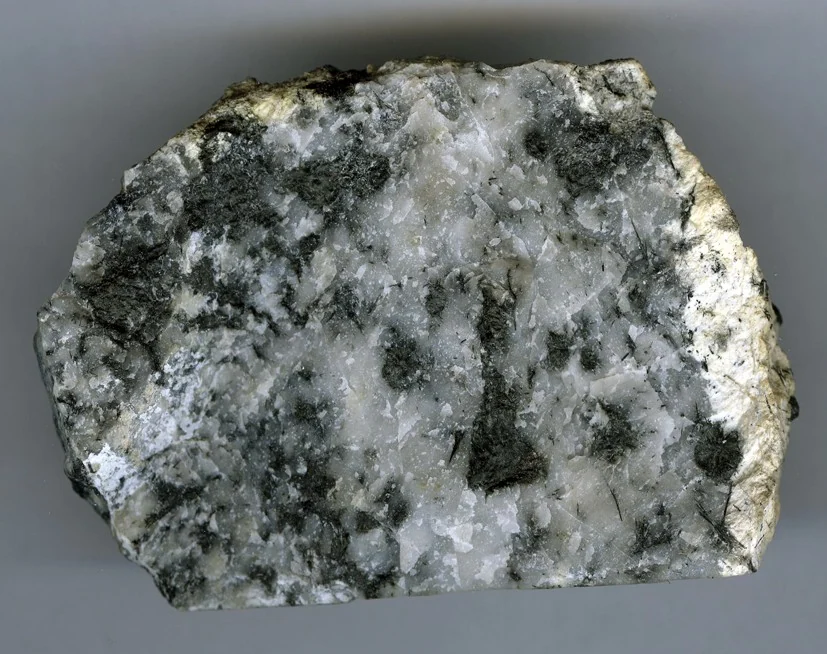
Pavel M. Kartashov · CC BY-SA 3.0 · WebP derivative

Raimond Spekking · CC BY-SA 4.0 · WebP derivative
Study the mineral
How to identify it
It can form dark prismatic crystals, fibrous aggregates or compact masses, with vitreous to submetallic gloss. The fibrous dress is not enough to attribute a species or to classify the material as an asbestos.
How it forms
It is associated with rocks rich in boron and iron, skarn and environments of contact metamorphism. The composition connects its formation to the availability of boron and iron in the host rock.
Uses and applications
It does not have a common industrial use; its value is mineral and petrological, especially for the study of borates in metamorphic rocks. The old formula must be verified with respect to the composition of the sample, not treated as unchangeable.
Laboratory question
Ludwigite is a structurally complex borate and a replacement of cations. If weaving is fibrous, the card describes the dress without inferring a risk or a normative classification from the appearance alone.
Compare other minerals in the catalogue
Sources and further reading
- Handbook of Mineralogy — Ludwigite
- Brovkin, A. A.; Rozhdestvenskaya, I. V.; Rykova, E. A. (2002) · Cation distribution in the structure of titanium-containing ludwigite Note: to be the mineral azoproite, Ti+Mg must be greater than Fe3+ in M4 site Note: Uiso values have been divided by 100
- Nomenclature and formulas · IMA–CNMNC
See also the historical museum card
 - Mg.2Fe[BO]5] -


MINERALOGICAL CLASS: Borato
GROUP: Trimetric
SYSTEM: Rombique
SPACE GROUP: Pbam
EDGEMENT:
ABITO: prismatic crystals, usually fibrous, in radial aggregates, at lamella, nodulari.
DUREZZA: 5
SPECIFIC PESO: 3,6
ROLE OF THE EUROPEAN COMMUNITIES=(1.830-1.850) β=(1.830-1.850) γ=(1.940-2.020) δ=(0.110-0.170)
COLOURS: Dark green, black
LIGHT: ♪
TRANSPARENCE: Translucent, matt
SFALDATURE:
STRISCIO: Dark green, black.
FRAME: Fragile, concoid
PLEOCROISMO: Strong, dark green, red-brown
GENESI: It forms in contact metamorphic rocks and in Skarn.
JACIMENTS: It is located in the United States, China, Russia Scandinavia. In Italy you can find it in Lazio.
HISTORY CENTRE: The name was given by Austrian chemist Ernst Ludwig in 1874.
OTHER CHARACTERISTICS AND USE: It is weakly soluble in acid. It alters in Limonite.
COMMENT: It has no particular uses but it can be an interesting mineral for collections, especially for intense green colour and fibrous form.
EXPENDITURE CHAMPIONS TO MUSEUM:
STANCE:
TECA:
DESCRIPTION CAMPIONE: