
Dawsonite
The dawsonite is basic carbonate of sodium and aluminium, NaAlCO3(OH)₂, a rare species crystallizes in the orthombique system. Its structure contains carbonate and oxydrile groups, it is not a simple altered feldspar.
From specimen to structure
Fibres or acicular aggregates
Teaching reconstruction of the dress. Colours and surfaces illustrate the appearance of the mineral. Indicative dimensions.
Reference photograph · Sound · CC BY-SA 4.0
Crystal unit cell
Coordinates of COD 9012812 diffraction. The spheres locate atomic sites and rods highlight the vicinity in the cell.
In the COD sample the cell edges are a = 6,762 Å, b = 10,428 Å e c = 5,593 Å. The α, β and γ angles are 90,00°, 90,00° and 90,00° respectively.
Composition reported in the sample record C H2 Al Na O5. Download the CIF · COD 9012812 · CC0
Elements and site occupancies in the unit cell
- Al 4,00
- C 4,00
- H 8,00
- Nana 4,00
- O 20,00
The totals are the sums of the site occupancies given in the CIF file.
Key data
- Class
- Coal
- Reference formula
- NaAl(CO)3(OH)2
- Mohs hardness
- 4
- Observed form in the model
- Fibres or acicular aggregates
- COD sample space group
- I 2 c m
- Sites represented by cell
- 40
Specimen photographs
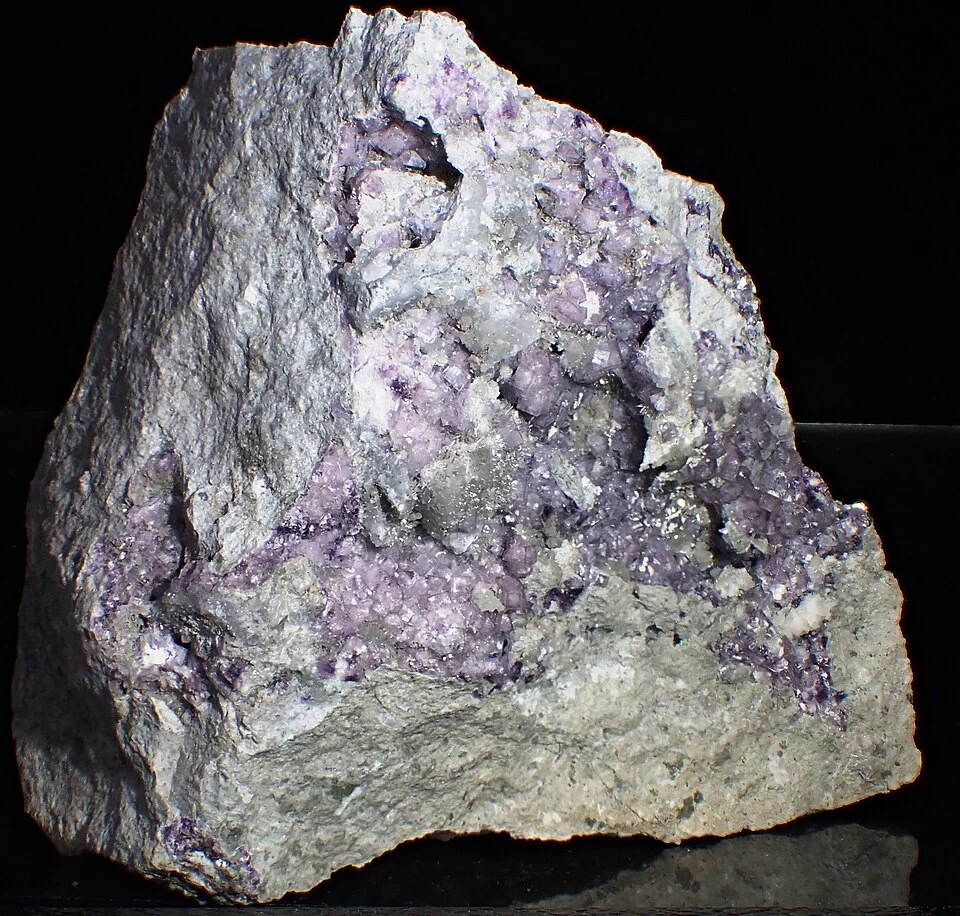
Look at the shapes, aggregates and colours of specimens from different collections.
Sound · CC BY-SA 4.0 · WebP derivative

Leon Hupperichs · CC BY-SA 3.0 · WebP derivative

GeologMax · CC BY-SA 4.0 · WebP derivative
Study the mineral
How to identify it
It is presented in acicular crystals, radial aggregates, crusts or white and colourless encrustations; the specimens can be minutes. The fibrous or subtle aspect is not enough to identify it without analysis.
How it forms
It is documented in geological environments rich in sodium and carbon, including cavities and sedimentary or volcanic rocks altered. Dawsonite training is also studied in relation to carbon mineralization in some basins, without implying that each occurrence is a useful deposit.
Uses and applications
It does not have a common industrial use as a mineral extract; its interest is scientific, especially for sodium and carbon geochemistry. It is useful as a phase example that can fix carbon in specific geological environments.
Laboratory question
It is used to discuss rare carbonates and carbon mineralization processes, alongside mineralogy analysis and balance models. Radial forms are an invitation to distinguish a crystalline aggregate from a dangerous fibrous species.
Compare other minerals in the catalogue
Sources and further reading
See also the historical museum card
 - NaAl[CO]3](OH)2 -


MINERALOGICAL CLASS: Carbonate
GROUP: Trimetric
SYSTEM: Rombique
SPACE GROUP: Imam
EDGEMENT:
ABITO: Acicular, radial or as intercrustations.
DUREZZA: 3
SPECIFIC PESO: 2,42
REFRATION INDEX:
COLOURS: Colorful or white
LIGHT: Vitrea
TRANSPARENCE: Transparent
SFALDATURE: {110} Perfect
STRISCIO: White
FRAME: Indistitute
PLEOCROISMO: Colour
GENESI: It is formed in a hydrothermal environment of low temperature.
JACIMENTS: It is located in many states of the USA, New Zealand, some regions of Africa and in many areas in Eurpa. In Italy it is located on the Alps and in Tuscany it is widespread in the province of Grosseto. You can also find it on the Amiata, in S.Fiora, Bagnore and Piancastagnaio.
HISTORY CENTRE: Discovered in 1874 in Canada, on a Feldspatic diak, later named after the Geologist John William Dawson.
OTHER CHARACTERISTICS AND USE: Soluble in acids and effervescent. It has no particular uses but it can be an interesting mineral for the collections seen its radiated appearance.
COMMENT: It has no particular uses but it can be an interesting mineral for the collections seen its radiated appearance.
EXPENDITURE CHAMPIONS TO MUSEUM:
STANCE:
TECA:
DESCRIPTION CAMPIONE: